If you plan to visit Malta, here is the complete list of the must-see places to visit.
Malta Travel Guide
Malta is often described as a destination of activities — dive here, hike there, taste this, sail that. But beneath the list of things to do lies something more enduring: a compact archipelago layered with places that feel both ancient and alive. Limestone cliffs rise from impossibly blue water. Prehistoric temples predate the pyramids. Fortified cities glow gold at sunset.
To understand Malta is not to chase activities — it is to move deliberately through its landscapes.
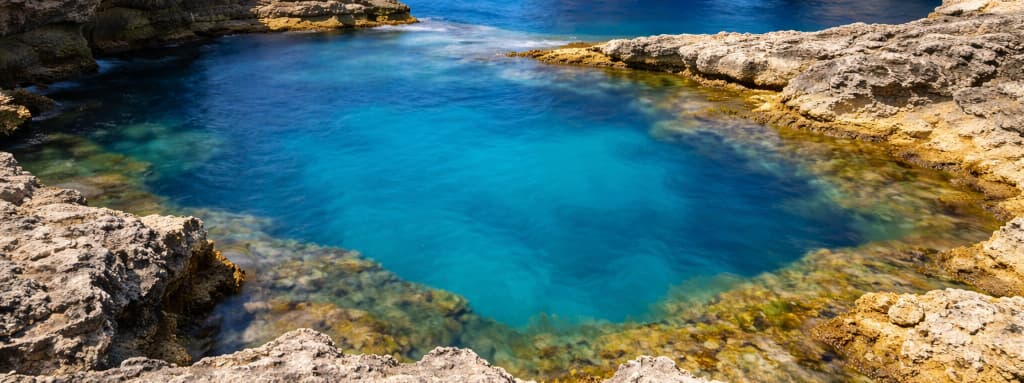
The Blue Hole and Dwejra Bay, Gozo
The Blue Hole — a vertical natural chimney carved into the limestone — is one of Malta’s most iconic geological formations. Divers descend through its narrow opening into an underwater cathedral of arches and swim-throughs. Even from land, the site commands attention. Waves crash against rock shelves, and the horizon stretches uninterrupted toward Africa.
Nearby stands the Wied il-Mielaħ Window, often called the “new Azure Window”. After the original Azure Window collapsed in 2017, this lesser-known arch became a symbolic successor.
The Megalithic Temples: Ħaġar Qim, Mnajdra, and Ħal Tarxien
Long before the Phoenicians, Romans, or Knights of St. John, Malta was home to temple builders. The megalithic sites scattered across the islands date back to around 3600 BCE — among the oldest free-standing stone structures in the world.
Ħaġar Qim and Mnajdra, perched above the southern coastline of Malta, feel deliberate and ceremonial. Their curved apses and aligned doorways suggest astronomical precision. Standing inside these structures, you sense not ruins, but intention.
Ħal Tarxien, closer to Valletta, offers a more immersive experience. The carvings — spirals, animals, altars — are intricate and unexpectedly refined. It is here that Malta’s prehistoric past feels most personal.
On Gozo, the Ġgantija Temples rise from the countryside. Though partially damaged in the 19th century, they remain monumental. The adjacent museum contextualizes what the stones alone cannot.
Valletta
Built by the Knights of St. John in the 16th century, the city is a fortress carved in honey-colored limestone. Streets run in precise grids. Balconies protrude in green and blue woodwork. Domes and bell towers punctuate the skyline.
Walk the city walls at golden hour and the Grand Harbour appears cinematic — bastions reflecting light, boats tracing silent lines across the water. From the Upper Barrakka Gardens, the view extends toward the Three Cities, reminding visitors that Malta’s history has always been maritime.
Inside the city, St. John’s Co-Cathedral houses Caravaggio’s dramatic masterpiece, The Beheading of Saint John the Baptist. The Grandmaster’s Palace, Fort St. Elmo, and the National Museum of Archaeology reinforce Valletta’s layered identity: military stronghold, religious center, and cultural archive.
Valletta is not large. But its density of history rivals capitals ten times its size.
Marsaxlokk: A Harbour in Color
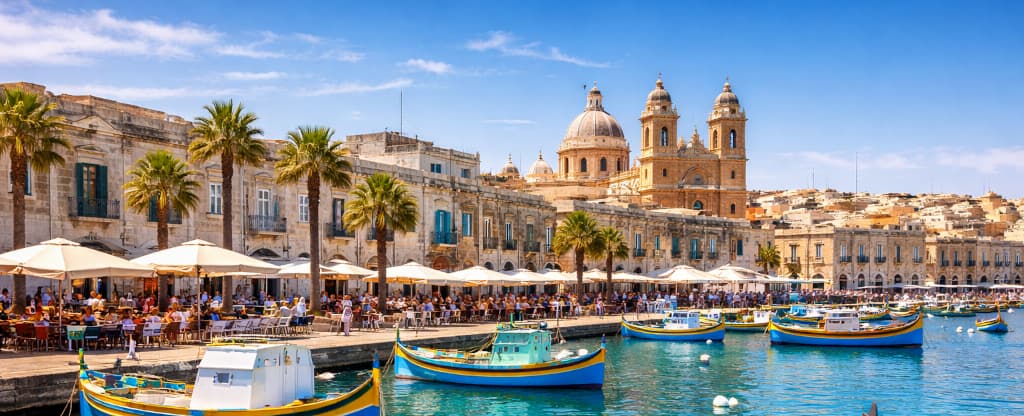
On Malta’s southeastern coast, Marsaxlokk offers a different rhythm. Traditional luzzu fishing boats — painted in bright blues, reds, and yellows — bob in the harbor. Their eyes, a Phoenician symbol of protection, face outward toward the Mediterranean.
On Sundays, the waterfront transforms into a market of seafood, produce, and local crafts. Yet even outside market hours, Marsaxlokk remains visually compelling. The contrast between the vivid boats and the pale stone buildings feels distinctly Mediterranean.
Dingli Cliffs: Malta’s Edge
At the island’s highest point, the Dingli Cliffs drop dramatically into open sea. There are no guardrails, no theatrical infrastructure. Only wind, rock, and horizon.
From here, the Mediterranean feels vast rather than enclosed. Small chapels sit improbably close to the edge, reinforcing the island’s long-standing dialogue between faith and landscape.
Visit at sunset and the cliffs shift from pale beige to deep amber. It is one of the few places in Malta where silence feels expansive.
Golden Bay: Structured Wildness
Golden Bay, on Malta’s northwest coast, is often described as a beach. But the surrounding headlands are what elevate it.
Hiking above the bay reveals layered cliffs, scrubland, and open sea views that feel almost cinematic. Surfers and swimmers animate the shoreline below, while the elevated trails offer perspective — both literal and figurative.
As the sun lowers, the bay becomes less recreational and more contemplative. The light refracts across the water in gradients of copper and rose.
Comino’s Blue Lagoon: Turquoise Minimalism
Between Malta and Gozo lies Comino, a sparsely inhabited island best known for the Blue Lagoon. The water here is strikingly clear — shallow turquoise over white sand.
In peak season, the lagoon is crowded. But approach it by kayak or outside peak hours, and its appeal becomes obvious. The surrounding cliffs and caves frame the water in clean, minimalist lines.
Xwejni Salt Pans, Gozo
On Gozo’s northern coast, the Xwejni Salt Pans form a geometric grid carved directly into rock. Locals have harvested sea salt here through evaporation.
From above, the pans resemble an abstract artwork — rectangles filled with shallow water reflecting sky and sun. Up close, the process feels methodical and ancient.
Sliema and the Three Cities: Living Counterpoints
Across the harbor, the Three Cities — Vittoriosa, Senglea, and Cospicua — feel quieter and more residential. Narrow alleys, maritime heritage, and less foot traffic make them ideal for those seeking authenticity without spectacle.