Malta is a real well of ancient buildings. The island has a history of more than 7,000 years and has monuments that are older than the Egyptian pyramids. That is why it has long attracted people who are interested in historical places, mysteries of the past, and unusual locations for exploration.
Remote viewing practitioners often choose places like this — places with history, symbols, and complex archaeology. Among popular Maltese targets people usually mention Ġgantija, the Bingemma Punic Tomb Necropolis, and the area of the former Azure Window. Malta is truly full of mysterious objects, and some of them still do not have a clear scientific explanation.
Remote viewing practitioners already have different experiments and claimed results in solving complex cases — for example, studies of pyramids.
In March 2025, a group of researchers (Corrado Malanga, Armando Mei, Filippo Biondi, and Nicole Ciccole) reported using SAR scanning — a non-invasive radar technology called synthetic aperture radar Doppler tomography — to study the Pyramid of Khafre. According to them, the data showed large underground structures and empty spaces under the Giza plateau. The tomography data were confirmed by several satellite operators.
If this interests you, you can try remote viewing practice. You can do it even while traveling or relaxing at our hotel — you only need a calm environment and prepared training material. There is a good remote viewing practice app, VEREVIO, where a pool of training targets, instructions, and beginner tips are already collected.
But let’s be realistic: regular practice is needed before you can become a remote viewing professional. Still, it is possible that you could be the one who helps solve the biggest mysteries of the island of Malta.
The Biggest Mysteries of the Island of Malta
Among the most frequently mentioned mysteries, researchers, travelers, and history enthusiasts usually highlight the following:
Cart Ruts — parallel grooves cut directly into the rock across the island. There is still no single clear explanation for their purpose. Some ideas are stone transport, farming work, or irrigation. Some tracks go into the sea, which may show rising water levels or the existence of ancient coastal settlements.
Hypogeum (Hal Saflieni) — an underground temple complex from about 4000 BC. It is notable for very precise stone work without metal tools, unusual acoustics, and symbols whose meaning is still not fully explained.
The megalithic temples Mnajdra and Ħaġar Qim are structures more than 5,500 years old, older than Stonehenge. Many parts are aligned with solar cycles, especially sunrise during solstices and equinoxes, which suggests astronomical knowledge. However, their exact function is still discussed because there are no written records explaining their purpose. Researchers debate whether they were temples, ritual centers, calendars, or something else.
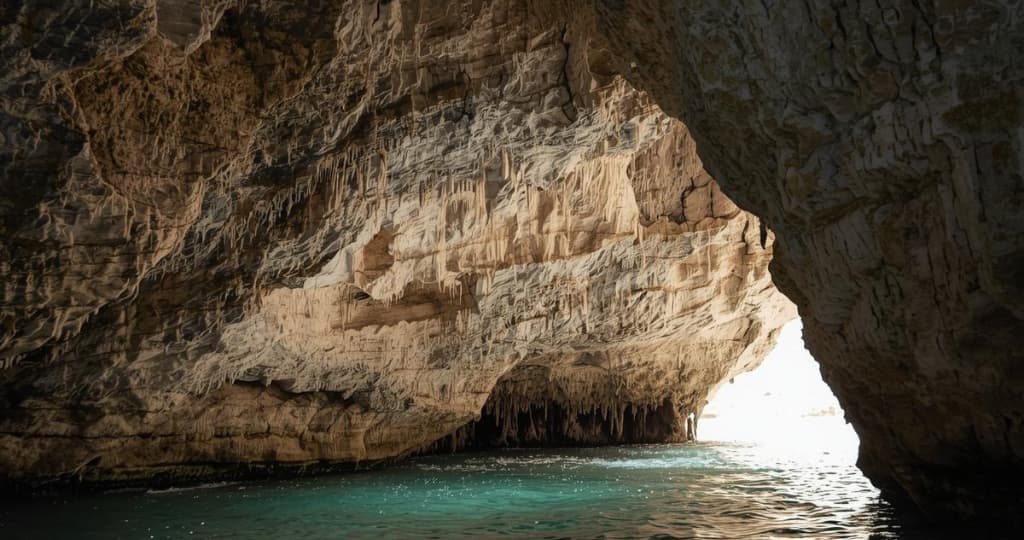
Calypso’s Cave — a place traditionally linked to the Odyssey. Scientifically it is a natural cave, although the poem, despite its mythology, describes a real historical period of Mycenaean Greece.
How to Remote View (Stages Explained)
From words to practice. Let’s go.
The first thing you need to understand is that remote viewing is not a skill, but a protocol which uses different ESP abilities. It has six stages that were proposed by the American Central Intelligence Agency.
At the first stage you receive a set of numbers used to connect you with a specific target. You make the connection and describe your first impressions of the target.
The second stage is about senses — for example what color the object has, what texture, or what temperature.
At the third step you try to recreate the shape of the object.
At the fourth stage you suggest what this object means or what purpose it has.
Then you try to interact with the target and add more characteristics.
At the final sixth stage you create a more complete picture from your impressions — something like a 3D model of the object.
As you already understand, training usually needs two people, which is not always comfortable or convenient. One person usually prepares the target and later checks the results, while the viewer focuses only on impressions. This is important because validation is the key part of remote viewing. It helps confirm whether the viewer is reliable and whether the target information is correct or can be confirmed later. Remote viewing can produce mind-blowing results when done properly, but without validation it becomes guesswork.
That is why an app with prepared training material is a very good solution when a second person is not available.
Also, your mental state is important when you practice. We are ready to help with that — in our hotel you can find calmness and comfort needed for privacy and for the pleasure of discovering something new.